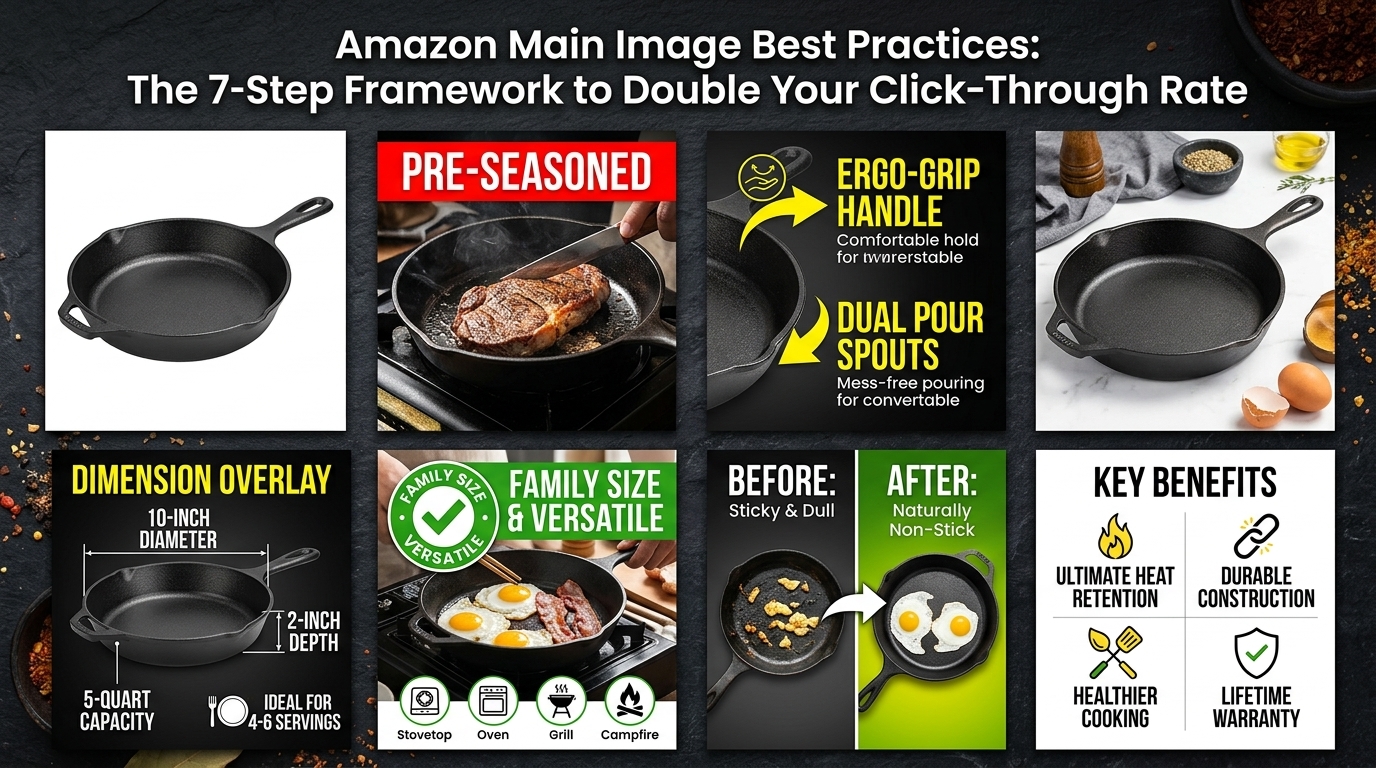
Your Amazon main image is costing you sales. Every day. Most FBA sellers lose 40-60% of potential clicks because their main image fails the 2-second SERP test. The average CTR for Amazon search results hovers around 2-3%, but sellers with optimized main images consistently hit 8-12% or higher.
Here’s the math that matters: If you’re getting 1,000 impressions per day at 3% CTR, that’s 30 clicks. Bump your CTR to 10% with proper main image optimization, and you’re getting 100 clicks from the same traffic. That’s 233% more potential customers seeing your listing.
Amazon main image best practices aren’t suggestions. They’re requirements for survival in a marketplace where 70% of purchase decisions happen in the first 15 seconds of viewing your listing.
Understanding Amazon’s Main Image Requirements and Algorithm Impact
Technical Specifications That Actually Matter
Amazon’s image requirements exist for a reason. The A10 algorithm factors image quality into ranking decisions, and non-compliant images get your listing suppressed faster than a trademark complaint.
Your main image must be 1000×1000 pixels minimum, but smart sellers upload at 2000×2000 pixels or higher. Why? Amazon’s zoom function only activates on images 1001 pixels or larger on the longest side. No zoom means lower engagement. Lower engagement signals poor user experience to the algorithm.
File size matters for load speed. Keep your main image under 10MB, ideally around 500KB-2MB. Slow-loading images kill mobile conversions, and 70% of Amazon shoppers browse on mobile devices.
RGB color space is mandatory, not CMYK. Save as JPEG for photographs, PNG for graphics with transparency. File naming should follow Amazon’s convention: ProductIdentifier_MainImage_1000x1000.jpg.
How the A10 Algorithm Evaluates Main Images
The A10 algorithm doesn’t just look at keywords. It measures user behavior signals, and your main image directly impacts three critical metrics: click-through rate, bounce rate, and time on listing.
Amazon tracks how long users spend looking at your main image before clicking. Images that generate clicks within 2-3 seconds of appearing in search results get ranking boosts. Images that get scrolled past signal poor relevance to the algorithm.
The algorithm also measures post-click behavior. If users click your main image but immediately bounce back to search results, that’s a negative ranking signal. Your main image must accurately represent your product to maintain healthy engagement metrics.
Conversion rate optimization starts with the main image. A 1% improvement in main image CTR typically correlates with a 0.3-0.5% improvement in overall listing conversion rate.
Mobile-First Optimization Reality
Most sellers design main images for desktop and wonder why their mobile conversions suck. On mobile, your main image appears as a 150×150 pixel thumbnail in search results. If your product isn’t clearly visible and identifiable at that size, you’ve lost the sale.
Test your main image at 150×150 pixels. Can you immediately identify what the product is? Can you see key features? If not, your image needs work.
Mobile users scroll 3x faster than desktop users. You have 1.5 seconds to stop the scroll with your main image. Busy backgrounds, multiple products, or unclear angles fail this test every time.
Product Positioning and Angle Strategy

The 45-Degree Rule for Maximum Impact
Product photography isn’t art. It’s sales psychology backed by eye-tracking data. The most effective main image angles follow predictable patterns based on product category.
For kitchen gadgets and tools, the optimal angle is 45 degrees from above-right. This angle shows both the top surface and front face, giving shoppers maximum product information in a single glance.
Beauty products perform best straight-on at eye level, with the product label clearly readable. Skincare items should show the full container with the product name prominent. Makeup items benefit from a slight upward angle to showcase the applicator or opening.
Electronics and gadgets require the 3/4 view angle. Position the product so viewers see the front face and one side panel. This shows depth and dimension while keeping the primary interface visible.
For supplements, straight-on positioning works best, but the bottle should be slightly angled to eliminate glare on the label. The supplement facts panel doesn’t belong in your main image, but the product name and brand should be crystal clear.
Size and Scale Communication
Amazon shoppers can’t physically handle your product before buying. Your main image must communicate size and scale without using prohibited elements like hands or rulers.
Use visual context cues within your product design. If you’re selling a kitchen tool, position it so the handle length is clearly visible. For electronics, ensure ports, buttons, and connectors are proportionally accurate to help buyers gauge overall size.
Avoid the “floating product” look that makes items appear undefined in size. Instead, use subtle shadowing or reflection to ground your product and give it weight and presence.
Product orientation should match how customers will use or display the item. A coffee mug should sit upright, not tilted at an artistic angle. A phone case should be positioned as if protecting a phone, even if the phone isn’t visible.
Multi-Product Main Image Mistakes
Unless you’re selling a specific set or bundle, multiple products in your main image split attention and confuse the algorithm’s image recognition. Amazon’s AI expects one primary product per main image.
The exception: true product bundles where customers buy all items together. In this case, arrange products in a clear hierarchy with the primary item largest and front-center. Secondary items should be 30-40% smaller to establish visual priority.
Avoid the temptation to show color variations in your main image. That’s what additional images and variations are for. Your main image should represent one specific product exactly as the customer will receive it.
Background and Lighting Optimization

Pure White Background Requirements
Amazon requires pure white backgrounds (RGB 255, 255, 255) for main images. This isn’t a suggestion, it’s policy enforcement. Images with off-white, gray, or cream backgrounds get flagged for non-compliance.
But pure white isn’t just about compliance. It’s about visual consistency across Amazon’s platform. When search results show a grid of products, consistent white backgrounds let your actual product stand out, not your photography style.
Use proper background removal techniques, not quick masking. Sloppy edge work around your product creates a halo effect that screams amateur hour. Professional background removal should be pixel-perfect, especially around curved edges and fine details.
Shadows and reflections can enhance your main image if done correctly. A subtle drop shadow adds depth and prevents the floating product look. Reflections work well for glossy products like electronics or beauty items, but they should be understated, not dramatic.
Professional Lighting Setup
Lighting makes or breaks product photography. Poor lighting creates color casts, harsh shadows, and uneven exposure that kills conversions.
The gold standard is three-point lighting: key light, fill light, and background light. Your key light should be the primary illumination, positioned at a 45-degree angle to your product. The fill light reduces harsh shadows, positioned opposite your key light at lower intensity. Background lighting ensures pure white without gray spots or color contamination.
Color temperature consistency matters. Use 5000K-5500K lighting to match daylight and ensure accurate color representation. Mixed color temperatures create color casts that make products look cheap or unnatural.
Avoid direct flash or harsh single-source lighting. This creates unflattering shadows and blown-out highlights that obscure product details. Soft, diffused lighting reveals texture and detail while maintaining even exposure across your product.
Color Accuracy and Brand Consistency
Color accuracy directly impacts return rates. If your product appears blue in the main image but arrives purple, you’ll get negative reviews and return requests that hurt your metrics.
Calibrate your monitor for accurate color representation. Use a color calibration tool to ensure what you see matches what customers see. Uncalibrated monitors can shift colors by 10-15%, leading to customer disappointment.
Brand colors should be consistent across all your product images. If your brand uses specific Pantone colors, ensure they’re accurately represented in RGB values for web display. Inconsistent brand colors confuse customers and dilute brand recognition.
Test your images on multiple devices. Colors appear differently on iPhone screens versus Android devices versus desktop monitors. Your main image should look accurate across all common viewing platforms.
Text, Graphics, and Compliance Elements
Amazon’s Text Restrictions
Amazon’s main image text policy is stricter than most sellers realize. No promotional text means no “Best Seller,” “#1 Choice,” “Free Shipping,” or “Sale” callouts. These belong in your PPC ads and secondary images, not your main image.
Product names and brand logos are generally acceptable if they’re part of the product’s actual packaging or design. But added text overlays are prohibited and will get your listing suppressed.
The gray area involves text that’s part of your product design. If your product label includes marketing copy, that’s usually acceptable. But don’t add extra text elements to your main image that aren’t physically present on the product.
Quality badges, certifications, and awards can’t be added to main images. Save these trust signals for your A+ Content and secondary images where they can actually impact conversion decisions.
Logo and Branding Guidelines
Your brand logo can appear in the main image if it’s part of the product’s physical design. But don’t add logos as separate graphic elements overlaid on the image.
Brand consistency across your catalog builds recognition and trust. If your logo appears on your products, ensure it’s clearly visible in main images. But if your products don’t include visible branding, don’t add logos artificially.
Watermarks are prohibited and unprofessional. They suggest you don’t trust Amazon’s platform and create visual clutter that detracts from your product presentation.
Keep branding subtle and product-focused. Customers are buying your product, not your logo. The product should dominate the frame, with branding elements supporting but not overwhelming the visual hierarchy.
Compliance Monitoring and Updates
Amazon’s image policies evolve constantly. What was acceptable six months ago might violate current guidelines. Set up monthly compliance audits to check your main images against current policy.
Use Amazon’s official image requirements documentation as your reference, not third-party interpretations. Policy changes often roll out gradually, affecting some categories before others.
Monitor your listings for suppression notices. Amazon often suppresses listings for image violations without detailed explanations. If your BSR suddenly drops or your impressions disappear, check image compliance first.
Keep backup versions of compliant main images. If Amazon flags an image for violation, you need replacement images ready to upload immediately. Listing downtime costs sales and ranking position.
Category-Specific Optimization Strategies

Beauty and Personal Care Specifics
Beauty products require different main image approaches than other categories. Label readability is critical because customers need to verify ingredients and product claims.
Position beauty products straight-on with labels parallel to the camera. Slight angles that show dimension are acceptable, but the primary product information panel must be clearly readable.
For skincare, show the full container including pump dispensers, caps, and applicators. Customers evaluate value based on visible product volume, so don’t crop these elements.
Makeup items should show the product in its closed, shelf-ready state. Open compacts or extended lipsticks belong in secondary images. Your main image should match how customers will store and display the product.
Color cosmetics require perfect color accuracy. Use color-corrected lighting and calibrated monitors to ensure the red lipstick in your image matches the red lipstick customers receive.
Kitchen and Home Product Guidelines
Kitchen products need to communicate functionality and scale simultaneously. A garlic press should be positioned to show both the pressing mechanism and overall size relative to its intended use.
Appliances should be photographed in their ready-to-use state. Coffee makers should have carafes in place, blenders should have lids attached, and food processors should show their primary bowl attachment.
For tools and utensils, position them as if ready for use but not actively being used. A spatula should be angled as if about to flip food, but without food present.
Scale communication is especially important for kitchen items. Use proportional elements within your product design to hint at size. The handle-to-head ratio on kitchen tools provides size context without violating Amazon’s policies.
Electronics and Tech Product Rules
Electronics main images should show the product’s primary interface clearly. For phones, show the screen. For headphones, position them as if worn. For keyboards, ensure key labels are readable.
Cable and connector products need close-up clarity. The connector type should be immediately identifiable, and cable length should be visually suggested through coiling or arrangement.
Avoid showing electronics powered on with glowing screens or LED indicators. This creates consistency issues and may not reproduce accurately across different viewing devices.
For accessories, show them in relation to their intended use without including the primary device. A phone case should be positioned as if protecting a phone, but the phone shouldn’t be visible in the main image.
Testing and Performance Measurement

A/B Testing Main Image Variations
Most sellers never test their main images. They upload once and wonder why conversions plateau. Systematic A/B testing of main image variations can improve CTR by 200-400%.
Create 3-4 main image variations testing different angles, lighting setups, or product arrangements. Change one variable at a time to isolate what drives performance improvements.
Test for minimum 14 days to account for weekly shopping pattern variations. Amazon’s traffic fluctuates significantly between weekdays and weekends, affecting the reliability of shorter tests.
Track both CTR and conversion rate changes. Sometimes a main image increases clicks but decreases conversions if it misrepresents the product. The goal is optimizing total sales, not just traffic.
Use Amazon’s native split testing tools where available, or create separate listings for controlled testing. Document your results to build a database of what works for your product categories.
Key Performance Indicators to Monitor
Click-through rate is your primary main image KPI. Track CTR by traffic source (organic search, PPC, external) to identify where your main image performs best and worst.
Conversion rate changes after main image updates indicate whether your image accurately represents your product. Improved CTR with declining CVR suggests your main image is misleading.
Return rate spikes often correlate with main image misrepresentation. If returns increase after a main image change, the new image may be setting incorrect expectations.
Monitor time on page and image engagement metrics through Amazon Brand Analytics. Customers who spend more time viewing your images typically have higher conversion rates.
Search impression share can indicate whether your main image helps or hurts algorithm ranking. Declining impressions after image changes suggest the algorithm ranks your listing lower.
Seasonal and Trend Adaptations
Your main image strategy should evolve with seasonal demand patterns and market trends. Q4 holiday shopping requires different image optimization than summer seasonal products.
Create seasonal main image variants that maintain compliance while adapting to shopping context. Holiday-themed background colors or seasonal product positioning can improve relevance.
Monitor competitor main image changes, especially from top-ranking listings in your category. If multiple successful competitors adopt similar image approaches, test those strategies for your products.
Track performance correlation with external trend data. Google Trends, social media activity, and seasonal search patterns can inform when to update your main images for maximum impact.
Plan main image updates 30-45 days before major shopping seasons. This allows time for algorithm adjustment and performance measurement before peak traffic periods.
Advanced Optimization Techniques
Image SEO and Metadata
Amazon’s algorithm reads image metadata, including alt text and file names. Optimize these elements even though customers don’t see them directly.
Alt text should describe your product clearly and include relevant keywords naturally. “Stainless steel garlic press with ergonomic handles” works better than “garlic-press-kitchen-tool-best-seller.”
File naming should be descriptive and consistent across your catalog. Use your ASIN or product identifier, followed by descriptive elements: “B08XXXX-StainlessSteelGarlicPress-MainImage.jpg”
Image compression affects load speed and mobile performance. Use tools that maintain quality while reducing file size. Slow-loading images hurt mobile conversions and algorithm rankings.
Upload images in order of importance. Amazon’s system processes images sequentially, so upload your main image first, followed by secondary images in order of conversion impact.
Cross-Platform Consistency
Your Amazon main image should align with your brand presentation on other platforms while meeting Amazon’s specific requirements.
Maintain visual brand consistency across Amazon, your website, social media, and other marketplaces. Customers research products across multiple platforms before buying.
Create platform-specific versions of your main image rather than using identical images everywhere. Amazon’s white background requirement differs from Instagram’s aesthetic preferences, but your product positioning and lighting should remain consistent.
Document your image guidelines and specifications to ensure consistency as you expand to additional marketplaces or update existing images.
Competitive Analysis and Positioning
Study the main images of top-ranking competitors in your category. Identify common elements that successful listings share, then find ways to differentiate while maintaining best practices.
Search result positioning affects how your main image should be optimized. If you typically rank in positions 1-3, your image competes directly with top listings. Lower ranking positions need more eye-catching differentiation.
Analyze competitor image weaknesses. If top competitors use poor lighting or confusing angles, superior image quality becomes your competitive advantage.
Create comparison charts showing how your main image approach differs from competitors. Use these insights to inform your image testing priorities and creative direction.
Monitor competitor image changes and performance correlations. When successful competitors update their main images, test similar approaches to see if they work for your products.
Frequently Asked Questions
How often should I update my Amazon main image?
Update your main image when performance metrics decline or when you have tested variations that show significant improvement. Most successful sellers review main images quarterly and test new variations every 60-90 days. Avoid changing main images during peak sales periods as this can temporarily hurt rankings while the algorithm adjusts.
Can I use lifestyle images as my main image?
No, Amazon requires main images to show the product on a pure white background without lifestyle elements, people, or additional props. Lifestyle images belong in your secondary image slots where they can effectively show product usage and benefits. Your main image must focus solely on the product itself.
What’s the minimum resolution for Amazon main images?
Amazon requires 1000×1000 pixels minimum, but successful sellers upload at 2000×2000 pixels or higher. Higher resolution enables Amazon’s zoom feature and provides better image quality across all device types. Keep file size under 10MB while maximizing pixel dimensions for best performance.
How do I know if my main image violates Amazon’s policies?
Monitor your listing performance for sudden drops in impressions or BSR ranking, which often indicate policy violations. Amazon sends violation notices through Seller Central, but these can be delayed. Use Amazon’s official image requirements as your compliance checklist and audit your images monthly.
Should I include packaging in my main image?
Only include packaging if customers will receive and use the product in that packaging. For items like supplements or beauty products where the container is the product, show the full package. For items shipped in separate packaging that customers discard, show only the actual product they’ll use and keep.